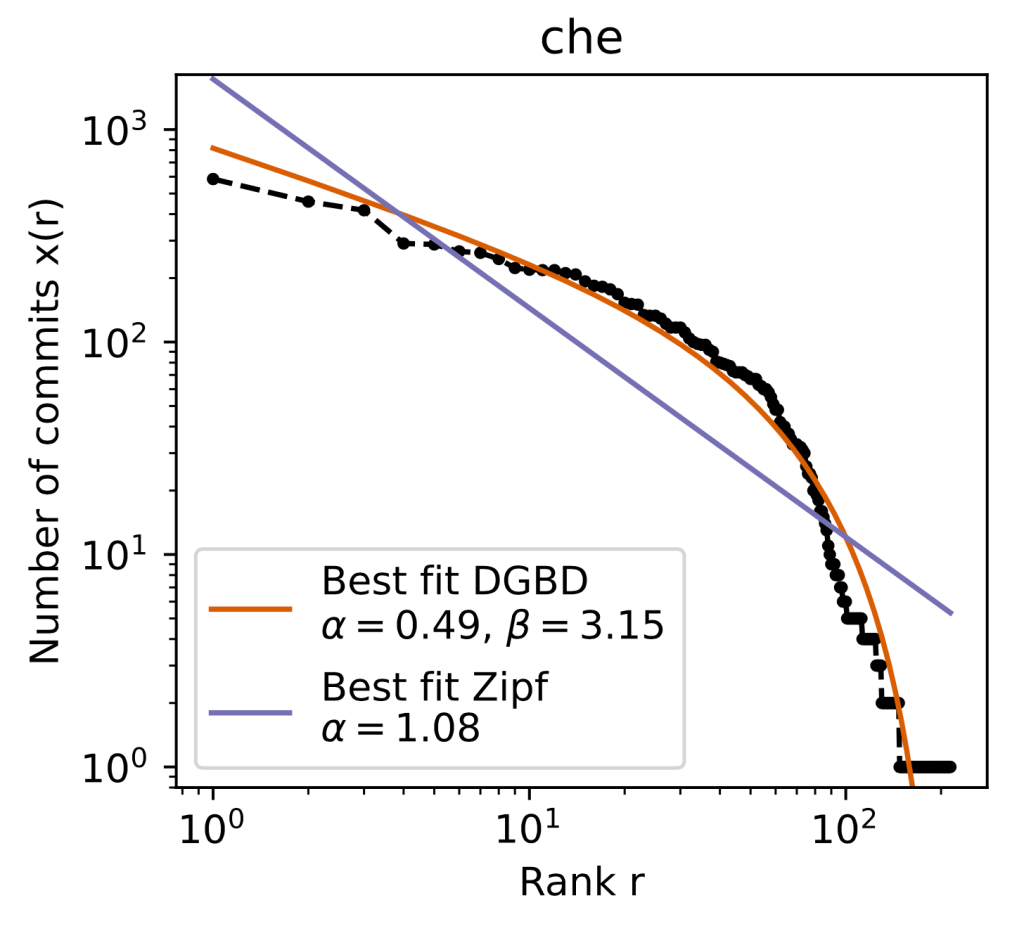
Open-source communities are often portrayed as flat, egalitarian systems—but empirical data tells a more complex story. Contribution patterns typically follow steep participation gradients, with a small number of core contributors and a long tail of peripheral participants. This study re-examines how we model such hierarchies and what these models imply for understanding community structure and governance.
Classic rank-size laws like Zipf’s have been used to characterize these inequalities, but they tend to focus on the extremes—particularly the “head” of the distribution—at the expense of the entire spectrum of participation. By introducing and validating the Discrete Generalized Beta Distribution (DGBD) as an alternative, this study offers a more nuanced lens to observe how different layers of contributors—core, occasional, and peripheral—interact and co-exist.
The implications extend beyond statistical modeling. They invite us to revisit key assumptions about who holds influence, how work is distributed, and what inclusion really looks like in open-source ecosystems. For researchers, it opens up new methodological paths to study community health, role fluidity, and social sustainability. For practitioners, it suggests more robust ways to assess participation beyond top contributors, supporting better tooling and governance design.
In short, this work contributes to the growing effort to treat open-source not just as a software production model, but as a sociotechnical system—one that can benefit from a more precise, whole-system understanding of its internal dynamics.
Published in Physica A: Statistical Mechanics and its Applications (2024).
Read the full article
 Interaction Data Lab