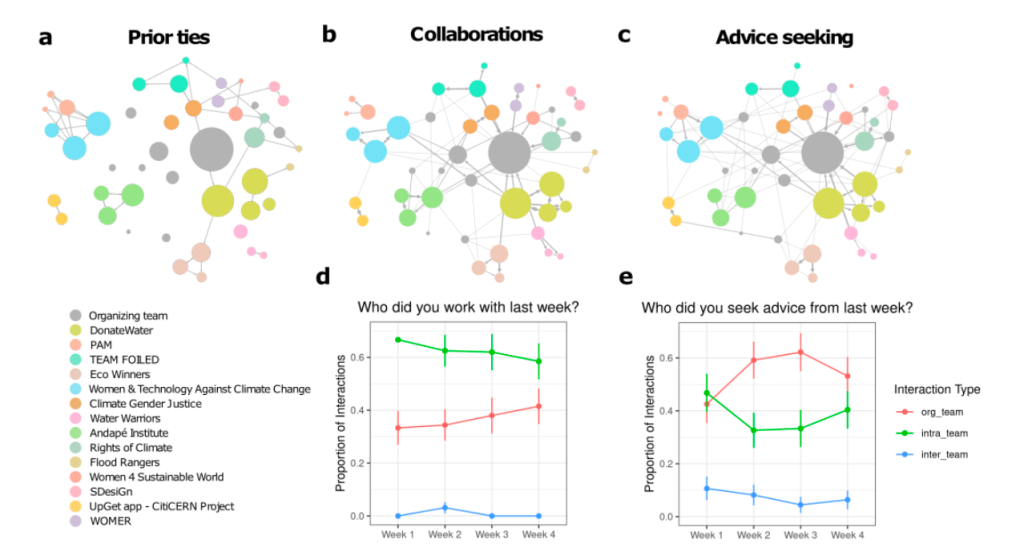
As part of the Crowd4SDG Horizon 2020 program, we developed and implemented a data-driven framework to monitor and evaluate participatory dynamics in early-stage citizen science teams tackling the Sustainable Development Goals (SDGs), with a focus on Climate Action (SDG 13). Our contribution centered on quantifying engagement, collaboration, and diversity in 26 interdisciplinary teams across two innovation cycles, using a combination of digital traces (Slack data) and self-reported surveys (CoSo platform).
We reconstructed multi-layer social networks reflecting formal and informal team interactions—collaborations, advice-seeking, and prior ties—and extracted features such as network centrality, communication frequency, and activity regularity. Using LASSO regression, we identified key predictors of project success and quality. Notably, team engagement, interdisciplinary composition, and strategic advice-seeking were consistently associated with higher project scores and advancement in the incubator. We also built a real-time dashboard to support facilitators in tracking interaction dynamics and improving inclusion and coordination.
Our findings are detailed in:
- Citizen Science: Theory and Practice: Collaboration and performance in citizen science projects.
- HAL Report on Statistical Models: Linking collaboration dynamics to project performance.
- HAL Report on the in-situ assessment of collaborations: Visualising engagement and collaboration networks.
- CoSo platform description (ACM 2021): Scalable collection of interaction data in online teams.
- PhD Thesis by Rathin Jeyaram: Chapter 2 offers an in-depth account of methods, results, and dashboard implementation.
This work showcases how network science approaches can support the design, facilitation, and evaluation of open innovation programs. Our methods are reusable for future science and innovation incubators aiming to foster effective teamwork and meaningful progress on global challenges.
 Interaction Data Lab