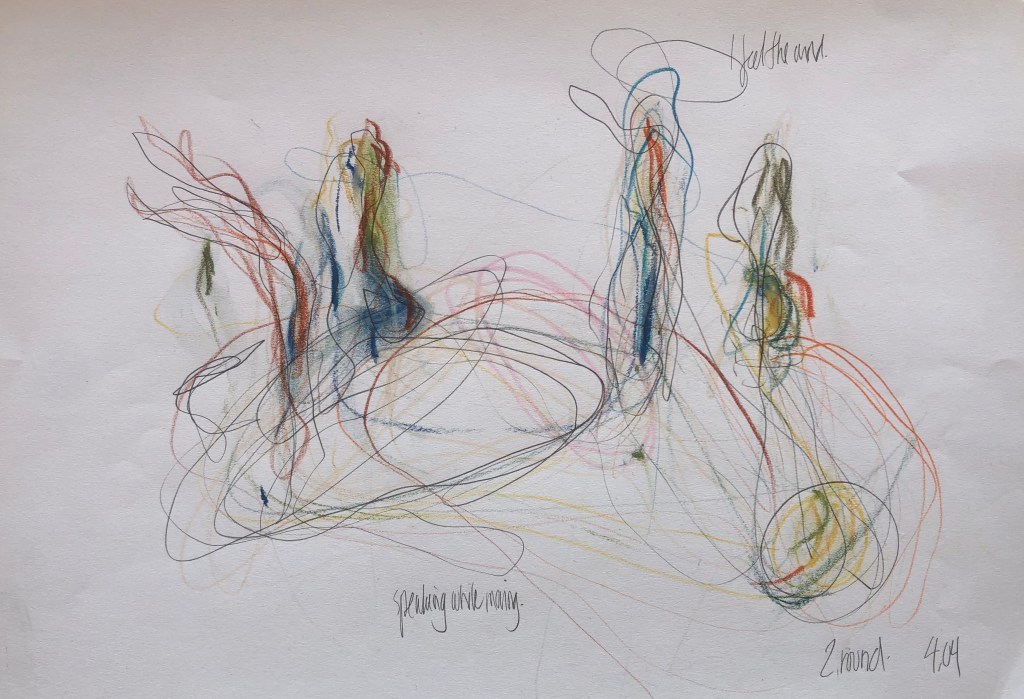
This project explores how relational, non-verbal social arts practices can become part of education for empathy, presence, and collective intelligence. Building on the Crafting Pedagogies of Togetherness residency (Studio Atelierista, Erasmus+ co-funded), we are developing curricula that help learners sense into the social field, regulate stress together, and engage with one another beyond words.
Our work translates embodied and awareness-based practices—such as Social Presencing Theater, movement inquiry, drawing, and awareness-based design—into pedagogical modules that educators and youth workers can adapt across schools, community programs, and lifelong learning settings. The guiding principle is simple: the body is not just an instrument for learning, but a site of knowing, and the way we show up together is itself a form of curriculum.
The emerging curriculum is structured around three pillars: Being Together (cultivating presence and safety), The Aesthetics of Togetherness (attuning to the felt and visible qualities of connection), and Relational Creativity (co-creating meaning and action from shared awareness). Practices progress across levels—self, dyad, group, and community—integrating nervous system regulation, non-verbal empathy, and polarity work. Rather than focusing only on cognitive skills, these practices help participants sense subtle dynamics, repair tensions, and access deeper forms of trust and shared creativity.
An important part of the project is narrative-based monitoring and evaluation. Instead of relying solely on surveys, we use reflective portfolios, storytelling prompts, and art-based outputs (drawings, movement sketches, voice notes) to capture shifts in felt safety, empathy, and group coherence. These narratives can then be analyzed both qualitatively and, where useful, with AI-assisted tools to identify broader patterns—without reducing the richness of lived experience to numbers alone.
The outcomes we aim for are multi-level: for learners, greater empathy readiness and comfort with ambiguity; for groups, stronger collective presence and resilience in the face of tension; and for educators, the confidence and tools to facilitate embodied, inclusive practices in their own contexts. In this way, the project bridges mindfulness, somatic regulation, social arts, and pedagogy to offer a holistic approach to learning and collaboration.
🔗 Drawing the Field: Art, Embodiment and the Science of Group Dynamics
https://studioatelierista.org/residency-paris-2025
 Interaction Data Lab